Photo credit: FIFA
Introduction
The U17 edition of football’s biggest international competition got underway yesterday in Qatar, with matches from Groups A, B, C and D taking place. Today, it is the turn of our young Red Devils to step onto the pitch. They will face Vietnam at 14:00 on Pitch 9 at the Aspire Zone.
This competition, which Belgium has now qualified for four times including this edition, is an important opportunity for our young players. It allows them to gain valuable international experience by taking part in a prestigious tournament while testing themselves against some of the best players in the world in their age group.
The 2009 generation will be eager to make its mark in Qatar after reaching the final of the UEFA European U17 Championship last May, where Belgium lost to Italy on penalties. There is therefore plenty of reason to be optimistic about this group.
So, what can we realistically expect from Belgium at the FIFA U17 World Cup?
The Road to Qatar
First of all, let’s take a look back at the journey that brought Belgium to this World Cup.
The Belgians began their campaign with a perfect record in Round 1 of the UEFA U17 Championship qualifiers, which took place on home soil. They defeated Moldova (1-0), Belarus (6-0) and Norway (0-2).
The U17s then repeated the feat in Round 2, beating Switzerland (2-1), Serbia (4-3) and Cyprus (0-1). These results officially secured their place at both the European Championship and the FIFA U17 World Cup.
Belgium therefore arrived at the Euros full of confidence and that certainly showed on the pitch. Having lost only to Spain during the group stage, the Belgians finished top of their group and secured their place in the knockout rounds.
In the semi-finals, they overcame a strong French side to book their place in the final against Italy.
The final remains a bitter memory for Belgian supporters. After a goalless contest, Noa Ojea Cobiella finally broke the deadlock in the 84th minute with a superb goal, one that only he seemed capable of producing. It looked as though the hardest part was done.
Unfortunately, Italy were awarded a penalty in the 90th minute and converted it to level the score, sending the game into a penalty shootout. Belgium eventually lost on penalties.
Despite the disappointment, reaching the final remains the best result in the country’s history at the UEFA U17 European Championship !
With such an impressive campaign, the 2009 generation proved that it can compete with the very best nations in Europe. The challenge now is to carry that form onto the world stage.
The Group
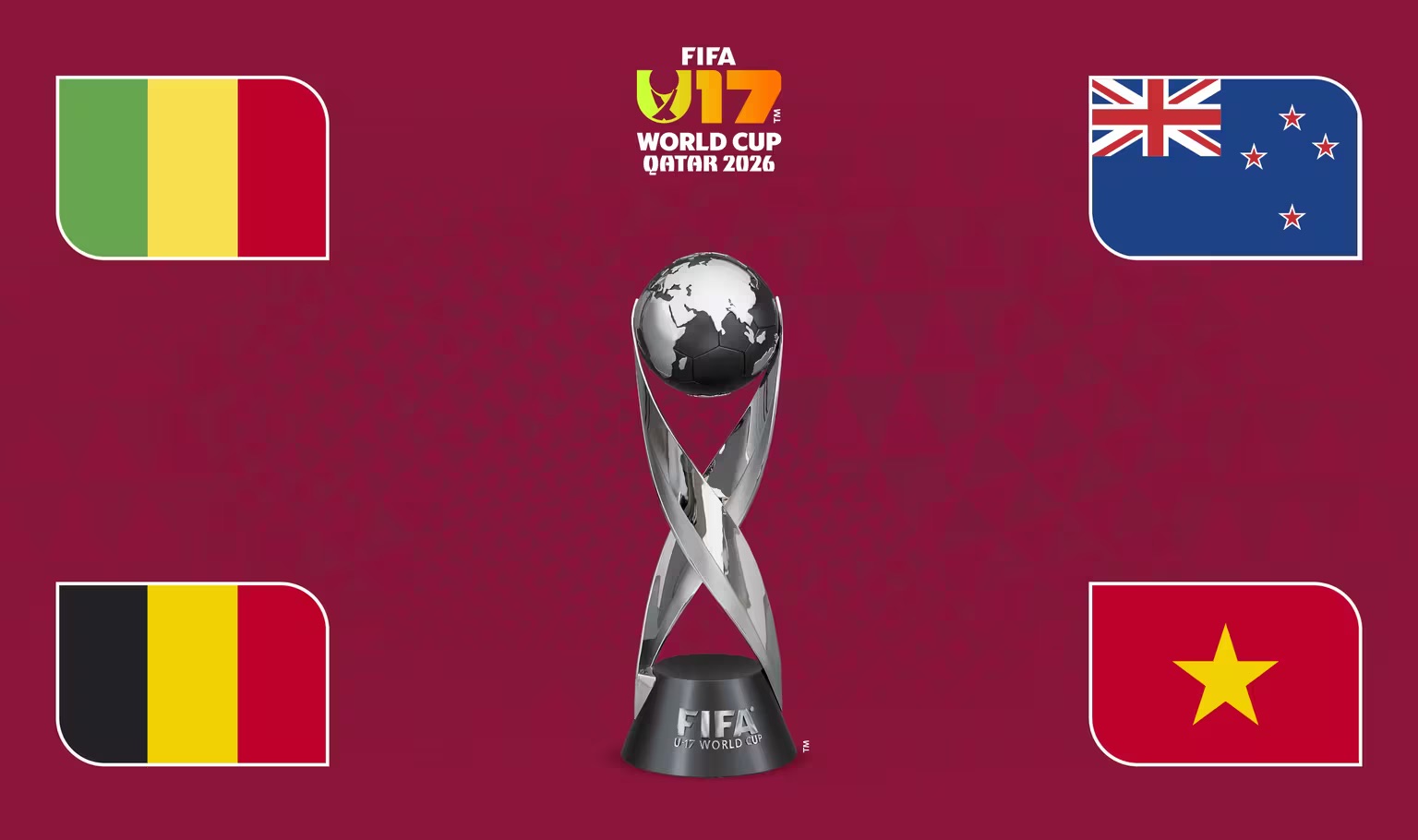
Belgium have been drawn in Group G alongside Mali, New Zealand and Vietnam.
Their first opponents will be Vietnam, who are making their first-ever appearance at a FIFA U17 World Cup. They qualified after reaching the quarter-finals of the AFC U17 Asian Cup.
On paper, Vietnam should be an opponent Belgium can beat. The Red Devils will be looking to start their campaign with three points and build some confidence ahead of the more demanding fixtures to come.
The Belgium vs Vietnam match will take place on 20 November 2026 at 14:00.
The second game will arguably be Belgium’s toughest test on paper, as they face Mali. Among the three opponents in the group, Mali holds the best historical record in this competition, having finished runners-up in 2015.
Mali qualified after reaching the quarter-finals of the CAF U17 Africa Cup of Nations.
This match should provide a first real test for our young Red Devils.
Mali vs Belgium will take place on 23 November 2026 at 16:00.
Belgium’s final group-stage opponents will be New Zealand, who appear to be the weakest side in the group despite having made 11 appearances at the FIFA U17 World Cup, compared to Belgium’s three previous appearances.
New Zealand qualified by winning the 2025 OFC U16 Championship. Since Australia left the OFC to join the AFC in 2007, New Zealand have won every edition of the continental competition. This dominance highlights the relatively limited competition they face within their confederation.
New Zealand vs Belgium will take place on 26 November 2026 at 14:00. This could prove to be an important fixture, not only for Belgium’s final group position but also in determining their potential opponent in the Round of 32, should they qualify.
As a reminder, the top two teams in each group qualify automatically, alongside the eight best third-placed teams.
Looking at the group as a whole, finishing first should be a realistic target for Belgium and arguably the objective they should set themselves. Failure to qualify for the knockout stages would be a major disappointment.
The Belgian Squad
On paper, several observers believe this squad is not quite as strong as the previous 2008 generation, which featured players such as Nathan De Cat, Jorthy Mokio, Noah Fernandez, Jesse Bisiwu, August De Wannemacker and Mohammed El Adfaoui, to name just a few.
However, the 2009 generation has actually achieved more than its predecessors at the UEFA U17 European Championship and arrives in Qatar with serious ambitions of its own.
Before looking at the squad in detail, it is important to address some major absentees. Four players born in 2009 who have featured for Anderlecht’s first team this season will not be part of the Belgian squad.
As the tournament is not taking place during a FIFA international window, clubs are under no obligation to release their players. Noah Kalonji, Jayden Onia Seke, Joshua Nga Kana and Noa Ojea Cobiella will therefore miss the tournament.
These absences will be particularly noticeable out wide, where the latter three players usually operate and bring plenty of quality. Losing three options on the wings is certainly a significant blow.
The absence of Sami El Morabet, who is recovering from an ACL injury, is another setback. We wish him a speedy recovery. Sami is an important member of this generation and his qualities at full-back will certainly be missed.
Another interesting feature of this squad is that none of the selected players currently play abroad, unlike last year’s generation, for example.
Let’s now take a closer look at the squad, broken down by position and shirt number. Shirt numbers can sometimes provide useful clues when trying to predict the starting line-up, particularly if we assume that Sven Vermant will stick with a 4-2-3-1 formation.
The positions listed below are those provided by FIFA. We will also try to predict what Sven Vermant’s strongest starting XI could look like, although some rotation and adjustments between games are to be expected. There should nevertheless be a fairly consistent core throughout the tournament.
Goalkeepers
1 – Mattis Seghers (RSC Anderlecht)
12 – Lowie Pisele (Royal Antwerp FC)
21 – Esteban Levaux (Standard de Liège)
Our take: Mattis Seghers is expected to start the tournament as Belgium’s first-choice goalkeeper, just as he did at the European Championship last June. His two backups are also great goalkeepers, however, and could step in if required. Both have already enjoyed several starts with this generation.
Defenders
2 – Tinus Moorthamer (KRC Genk)
3 – Elie Mbavu (KRC Genk) – Captain
4 – Preben Blondeel (KAA Gent)
5 – Assil Saidi (KRC Genk)
14 – Leni Strouwen (Club Brugge)
15 – Mamadou Balde (Club Brugge)
20 – Edgard Opoku (KAA Gent)
Our take: The centre-back pairing will almost certainly consist of team captain Elie Mbavu and Gent defender Preben Blondeel.
Elie is a true leader on the pitch, both for his club, Jong Genk, and for his national team. He is an excellent defender who knows how to shut down opposition attacks, win his duels and make life difficult for opposing forwards. He is also very comfortable on the ball, capable of building attacks from the back with accurate passes that break through opposition lines.
He is arguably the player to watch in this Belgian squad.
At right-back, we expect to see Tinus Moorthamer, who was also the first choice in that position at the Euros. On the left, Assil Saidi or Rayan Garcia could be given the nod.
Midfielders
6 – Louie Van Gelder (Royal Antwerp FC)
8 – Xander Dierckx (Royal Antwerp FC)
10 – Jelle Driessen (KRC Genk)
19 – Djibril Gbemou (Standard de Liège)
Our take: Belgium’s midfield features one of the most highly valued players in the tournament according to Transfermarkt, Xander Dierckx, who is currently valued at €5 million.
Xander made his Jupiler Pro League debut almost a year ago, on 30 November 2025 against Club Brugge. Since then, he has gained valuable experience at the highest level of Belgian football, something that should certainly benefit him during this World Cup.
He is a player who is never afraid to push forward. His passing ability and football IQ make him stand out in midfield.
He is likely to be partnered by Louie Van Gelder in a more defensive role, with Jelle Driessen operating further forward and providing an additional attacking threat.
Forwards
9 – Ilyas Benktib (RSC Anderlecht)
7 – Rayan Garcia (KAA Gent)
11 – Kiyan Achahbar (KRC Genk)
13 – Al-Hassan Kamara (Club Brugge)
16 – Niels Filippo (Royal Antwerp FC)
17 – Anthony Philips (KV Kortrijk)
18 – Matteo Soria (Club Brugge) – Born in 2010, the only player playing above his age group
Our take: The attacking positions are perhaps the most difficult to predict compared to the other areas of the team.
Nevertheless, Kiyan Achahbar should be in line to start on the left wing. Kiyan is an exciting player, blessed with excellent dribbling ability in one-on-one situations and tremendous acceleration over the first few meters. He could be the X-factor in this attack, with the ability to unlock a game at any moment.
The centre-forward position is likely to be contested between Ilyas Benktib and Matteo Soria, the latter being the only player born in 2010 in the squad.
Despite playing above his age group, Matteo has already featured in several Challenger Pro League games for Club NXT and has even found the net. It is worth noting that Ilyas can also play in midfield, meaning it would not be surprising to see both players start together during this World Cup.
The right-wing position could be occupied by Anthony Philips, who has already made seven appearances in the Jupiler Pro League for KV Kortrijk. He can also operate as a number 8 or number 10.
Al-Hassan Kamara could also push for a starting spot, thanks to his impressive pace and ability to stretch opposition defences.
We should not forget Rayan Garcia either. If he is not selected at full-back, he could feature further forward on the wing. Kiyan Achahbar could also switch to the right-hand side, rather than starting on the left.
It is also worth noting that Belgium have three players among the 20 most valuable players at the tournament according to Transfermarkt: Xander Dierckx (€5m), Elie Mbavu (€3m) and Preben Blondeel (€1m).
Belgium’s predicted starting XI
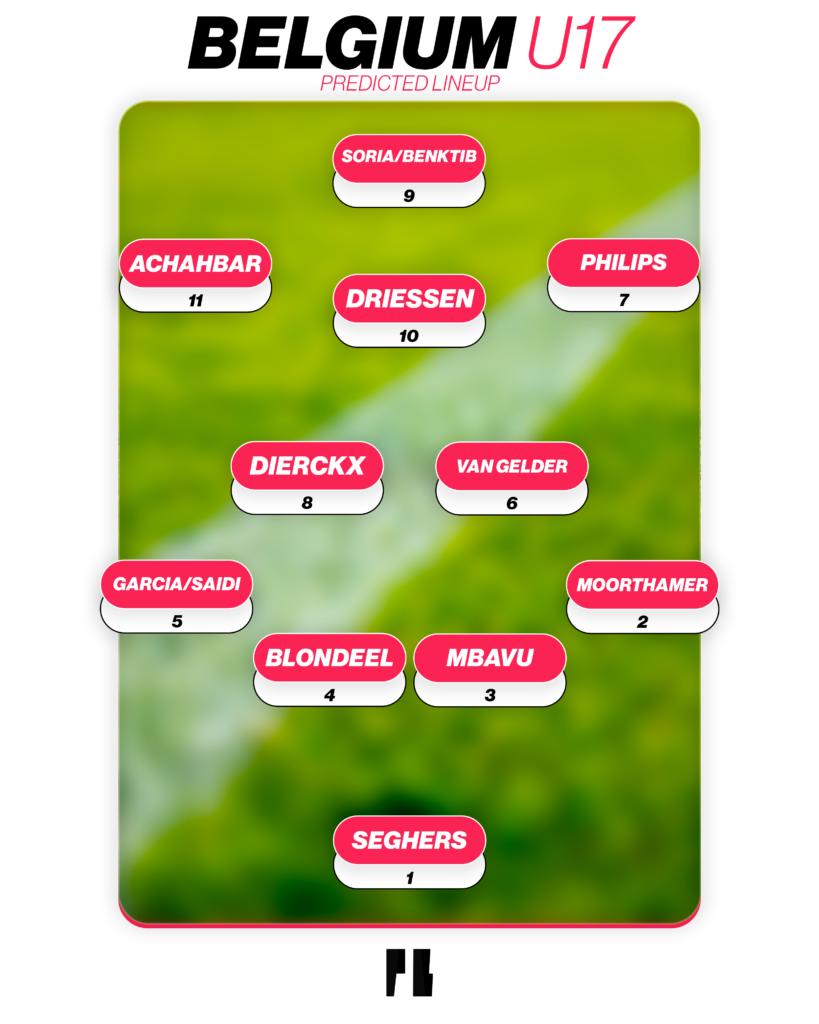
Based on the squad numbers, the players’ profiles and the assumption that Sven Vermant will use a 4-2-3-1 formation, Belgium’s starting XI could look something like this:
Conclusion
Head coach Sven Vermant is not hiding his ambitions. Speaking to FIFA, he made his intentions clear:
“We go for the highest [target] possible, and we want to get to the final. Maybe that’s big to set as an ambition, but I think you have to dare to say it.” Check the full interview of Sven Vermant made by FIFA here.
Those words set the tone for the tournament and show the mentality with which this group will approach the competition.
Of course, we cannot say that failing to win the World Cup would be a failure. Far from it. Furthermore, without knowing which opponents Belgium could face in the knockout stages, it is difficult to make any firm predictions about how far they could go.
However, we can reasonably expect this generation to improve on last year’s result. Reaching the Round of 16 would already represent a step forward, while a run to the quarter-finals would be an ambitious but realistic target.
And from that point onwards, anything is possible!
We will get our first glimpse of what this Belgian side can achieve today at 14:00 against Vietnam.
The match will be available in French on RTBF Audio and Pickx Showcase FR, in Dutch on Sporza and Pickx Showcase NL and in English on FIFA+.